
Lighting & Fixture Installation Services
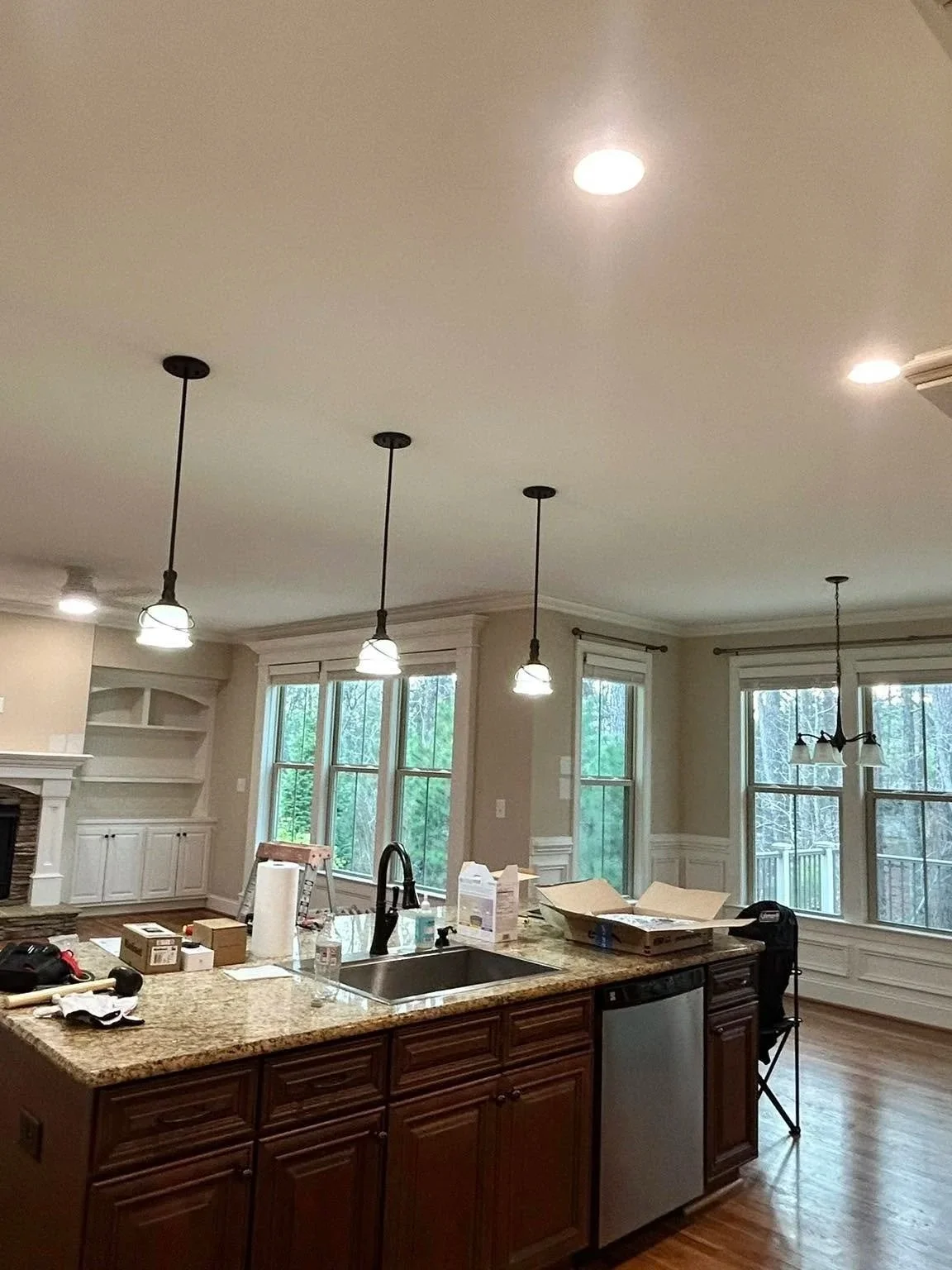
CurrentMax Electric delivers code-compliant residential lighting and fixture installations for homeowners throughout Wake County and beyond in North Carolina. From ultra-thin recessed wafer LEDs and heavy-duty ceiling fans to grand chandeliers and smart dimmers, our licensed electricians handle every installation with precision framing support, dedicated circuits, and clean, seamless drywall integration.
We supply and install contractor-grade fixtures, structural boxes, and smart home controls engineered for performance, safety, and longevity:
Recessed & Architectural Lighting: Canless ultra-thin LED wafers (IC-rated, airtight, switchable 2700K–5000K CCT) from brands like Halo, Lithonia Lighting, and Juno.
Ceiling Fan Systems: Heavy-duty, UL-listed dynamic load ceiling fan boxes and expandable bar hangers (rated up to 70 lbs for fans and 150 lbs for static fixtures) supporting Hunter, Casablanca, and Big Ass Fans.
Foyer & Chandelier Suspensions: Reinforced steel blocking, motor-driven chandelier hoists (Aladdin Light Lifts), and scaffolding for ceilings 12 feet and above.
Exterior & Security Illumination: Dusk-to-dawn photocells, dual-head PIR motion floodlights, and low-voltage architectural landscape lighting fixtures (FX Luminaire, Kichler, Ring Wired Plus).
Smart Lighting Controls & Dimmers: Neutral-wire smart dimmers, multi-location companion switches, and automation bridges (Lutron Caséta, Lutron Diva Smart, Leviton Decora Smart, and Philips Hue hardwired modules).
Service Capabilities & Equipment
100% Permitted & Inspected Work — Protecting Your Home's Warranty & Insurance
Local Permitting & NEC Code Compliance
Every lighting and fixture project executed by CurrentMax Electric complies with National Electrical Code (NEC) standards and municipal residential building codes:
-
Mandates that all ceiling boxes in habitable rooms capable of supporting a ceiling fan must be specifically listed and marked as fan-support rated, preventing catastrophic falls caused by continuous rotational vibration.
-
Strict horizontal and vertical clearance requirements prohibiting exposed-bulb incandescent luminaires; requires fully enclosed or recessed LED fixtures with safe clearances from clothing storage shelves.
-
Proper use of Type IC (Insulation Contact) rated housings to eliminate thermal hazards where ceiling insulation touches recessed luminaires.
-
Enforces dedicated neutral conductors in every lighting switch box, guaranteeing safe power for smart dimmers and IoT switches without grounding-conductor leakage.
-
We pull trade electrical permits through your local building department whenever new circuits or panel tie-ins are required, arranging the rough-in and final safety inspections on your behalf.
Transparent Cost Factors: What Shapes Your Estimate
We believe in upfront, straightforward pricing with no hidden surprises. The total investment for your lighting installation depends on four primary variables:
Attic & Ceiling Accessibility: Open, unfinished attics allow our team to route new wiring cleanly and quickly with minimal labor. Finished ceilings, cathedral framing, or multi-story homes require specialized fish-tape routing or minor drywall access points.
Structural Support & Box Anchoring: Replacing an existing fixture on an already approved electrical box is quick and direct. Installing heavy chandeliers or dynamic paddle fans requires retrofit steel spreader braces or reinforced framing to meet code.
Circuit Run Distance & Panel Headroom: Tapping into an existing, under-capacity lighting circuit keeps material and labor costs low. Running brand-new dedicated 15A or 20A lines back to your main electrical panel adds wire length and conduit runs.
Ceiling Height & Staging: Standard 8- to 9-foot ceilings can be serviced quickly using standard step ladders. Multi-story entryways, vaulted ceilings, or 14+ foot foyers require specialized staging, scaffolding, and multi-electrician installation teams.
Step-by-Step Installation Process
Site Assessment & Load Calculation
Prerequisite load check before cutting or roughing in.
We map your fixture locations, verify structural framing using stud and joist sensors, and evaluate your existing circuit capacity to ensure the new lighting array or motor load does not exceed 80% continuous branch circuit limits.
Permitting & Material Preparation
Ensures local municipal approval.
Our team files required electrical permits with the local municipality, plans the cable pathway (minimizing drywall cuts), and prepares UL-listed housings, cables, and switch controls.
Precision Rough-In & Fixture Installation
Brief power shutdown
We cut clean cutouts using dust-containment tools, run NM-B (Romex) or MC cable, anchor fan-rated or heavy-load ceiling boxes, connect conductors using verified ground bonding, and mount your fixtures and smart controls.
Code Inspection, Testing & Utility Sign-Off
Full circuit safety verification.
We verify voltage drop, test polarities, calibrate smart dimmer low-end trim to prevent LED flicker, balance ceiling fan blades, and coordinate final sign-off with your local building inspector.
Frequently Asked Questions
-
Yes. We install ultra-thin canless LED wafer lights that clip directly into drywall using spring-loaded retention clips. In homes without attic access, our electricians use specialized flexible drill bits and fish tapes to route cables horizontally between joists, minimizing drywall intrusions to small, easily patchable access holes when structural cross-beams are present.
-
Standard ceiling light boxes are typically made of lightweight plastic or light-gauge stamped steel rated only for static loads up to 50 lbs. Ceiling fans generate constant dynamic rotational vibration and torque. Under NEC 314.27(C), fans must be supported by a box specifically listed and labeled for ceiling-fan support, anchored directly to joists or an expanding steel spreader bar.
-
Most modern smart dimmers (such as Lutron Caséta Smart Dimmers or Leviton Decora Smart) require a dedicated neutral conductor to power their internal Wi-Fi/RF radios while the light is off. While older homes may only have a 2-wire switch loop without a neutral, our electricians can either pull a neutral conductor to meet NEC 404.2(C) standards or install no-neutral smart dimming systems designed for older wiring.
-
Modern LED wafer lights consume very little energy (typically 9 to 15 watts per light), meaning 10 recessed lights often draw around 1 to 1.25 amps. During our initial load calculation, we check the existing devices on that circuit to ensure the total draw remains within the 80% continuous load threshold of your 15-amp or 20-amp breaker.