
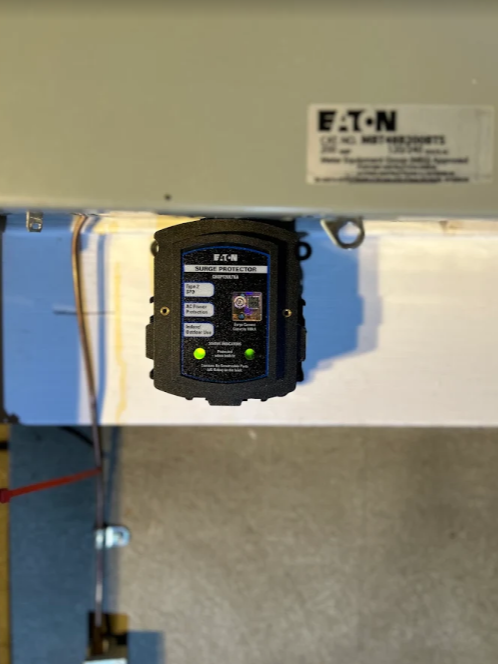
Whole-Home Surge Protection Services
CurrentMax Electric installs comprehensive whole-home surge protection systems for homeowners throughout Wake County and beyond. Safeguard your sensitive electronics, smart appliances, HVAC compressors, and solar integrations directly at the electrical service panel with commercial-grade Type 1 and Type 2 surge protective devices (SPDs) installed by licensed electricians.
Service Capabilities & Equipment
We supply and install industrial-grade, multi-stage surge protective devices and panel-level hardware engineered to divert high-voltage transients safely to ground:
Type 1 Surge Protective Devices (Meter/Service Entrance): Heavy-duty line-side protectors installed before the main disconnect to protect against external utility switching spikes and indirect lightning strikes (e.g., Square D Surgelogic, Siemens FirstSurge Pro).
Type 2 Panel-Mount SPDs (Branch Distribution): Load-side protectors wired to a dedicated dual-pole breaker inside your primary panel to arrest incoming and internally generated transients (Eaton CHSPT2ULTRA, Leviton Whole-House Surge, Square D HEPD80).
Dedicated Breaker & Bussing Hardware: High-interrupting-capacity circuit breakers paired directly with brand-specific load centers (Square D QO/Homeline, Siemens, Cutler-Hammer/Eaton, GE Powermark).
Point-of-Use & Subpanel Defense: Type 3 secondary arrestors for detached garages, subpanels, mini-split heat pumps, and electric vehicle charging circuits.
Status Monitoring & Audible Diagnostics: SPDs with multi-phase LED status beacons and audible alarms that immediately notify you when a sacrificial metal oxide varistor (MOV) bank has reached end-of-life.
Code Compliance & NEC Safety Standards
100% Code-Compliant Work — Protecting Your Home's Warranty & Insurance
Whole-home surge protection is no longer optional—it is a critical life-safety standard enforced by modern electrical codes:
-
Governs the listing, ratings, and correct conductor sizing for SPDs, ensuring devices match the phase configuration and nominal system voltage of your residential service.
-
Requires all newly installed, upgraded, or replaced dwelling unit service equipment to have an integral or adjacent Type 1 or Type 2 SPD, protecting downstream life-safety devices like AFCI/GFCI breakers and smoke alarms.
-
Strict installation protocols keeping SPD phase, neutral, and ground conductors as short and straight as possible (under 12–18 inches) to minimize high-frequency inductive reactance, which can degrade surge diversion performance.
-
Verifies the low-impedance ground path to the grounding electrode system (ground rods/water pipe bond); a surge protector cannot effectively discharge excess energy without a verified, low-resistance ground reference.
-
We file necessary electrical permits with your local building authority for service panel modifications and coordinate the final inspection sign-off.
Transparent Cost Factors: What Shapes Your Estimate
Pricing for surge protector installation is straightforward and depends primarily on your existing panel setup and available capacity:
Panel Space & Breaker Headroom: Installing an SPD requires two adjacent breaker slots (a dedicated 240V dual-pole breaker). If your panel has open space, installation is quick. If the panel is completely full, we may need to install tandem/quad breakers or a subpanel.
Panel Age & Bus Bar Compatibility: Modern panels with available OEM parts are straightforward. Older, obsolete panels (such as legacy Zinsco, Federal Pacific, or split-bus models) often lack compatible breaker hardware and may require a service update or an external line-side Type 1 mount.
Surge Current Capacity Rating (kA): Entry-level residential units range from 50kA per phase, while premium commercial-grade residential units offer 108kA to 140kA ratings with thermal-fused MOVs and higher surge endurance.
Grounding Electrode Integrity: If your home's exterior grounding system has loose ground rod clamps, missing bonding jumpers, or corroded grounding conductors, the grounding path must be repaired to ensure the SPD functions properly during a spike.
Step-by-Step Installation Process
Panel Inspection & Grounding Evaluation
Evaluates bus condition, breaker headroom, and ground path
We remove the panel deadfront, evaluate the service capacity, check for two adjacent breaker spaces nearest the main lugs, and test the grounding electrode conductor for proper bonding.
Permitting & Hardware Specification
Selects proper kA rating and files local paperwork
We select the appropriate Type 1 or Type 2 unit based on your panel manufacturer (Square D, Eaton, Siemens) and desired surge capacity, then pull the necessary residential permit.
Precision Mounting & Conductor Routing
Keeps leads short and direct to maximize suppression.
We punch an accessible knockout adjacent to the panel, secure the SPD housing, connect the device via a dedicated 2-pole 20A–50A breaker, and route the phase, neutral, and ground leads with minimal bends.
Energization, Diagnostics & Safety Testing
Verifies indicator status and completes inspection sign-off.
We energize the breaker, test phase-to-neutral and phase-to-ground clamp voltages, confirm the green diagnostic status LEDs are active, and arrange final city or county inspection.
Frequently Asked Questions
-
Plug-in strips (Type 3 devices) only protect the individual electronics plugged into that specific outlet, and they cannot protect major appliances like your refrigerator, HVAC compressor, water heater, washer/dryer, or hardwired smart switches. Furthermore, standard strips cannot handle the massive voltage spikes from lightning strikes or utility grid switching that a panel-mounted SPD absorbs.
-
The NEC mandated whole-house surge protection in modern code revisions (Article 230.67) because today's homes are filled with microprocessors—even in basic appliances and safety devices. Voltage transients can silently damage the delicate electronics inside AFCI (Arc-Fault) breakers, GFCI outlets, smoke detectors, and smart panels, creating safety hazards without tripping a conventional breaker.
-
Quality whole-home SPDs feature visual diagnostic status lights (and often audible alarms). As long as the indicator LEDs show green, the internal metal oxide varistor (MOV) modules are intact and active. If an LED turns red, flashes, or turns off, the unit has sacrificed its protective bank to save your home's electrical system and needs replacement.
-
A whole-home SPD is designed to divert secondary lightning surges—such as a strike hitting a nearby utility pole or power line down the street—which account for the vast majority of lightning-related electrical damage. However, no surge protector can stop a rare direct hit to the roof of a house; comprehensive defense against direct strikes requires a dedicated lightning rod (air terminal) system tied to ground.